
How to start a business in 2026 is easier to approach when you focus on solving a real problem instead of trying to build everything at once. New technology has created more ways to sell products, provide services and reach customers than ever before. The key is choosing the right opportunity and turning it into a practical business.
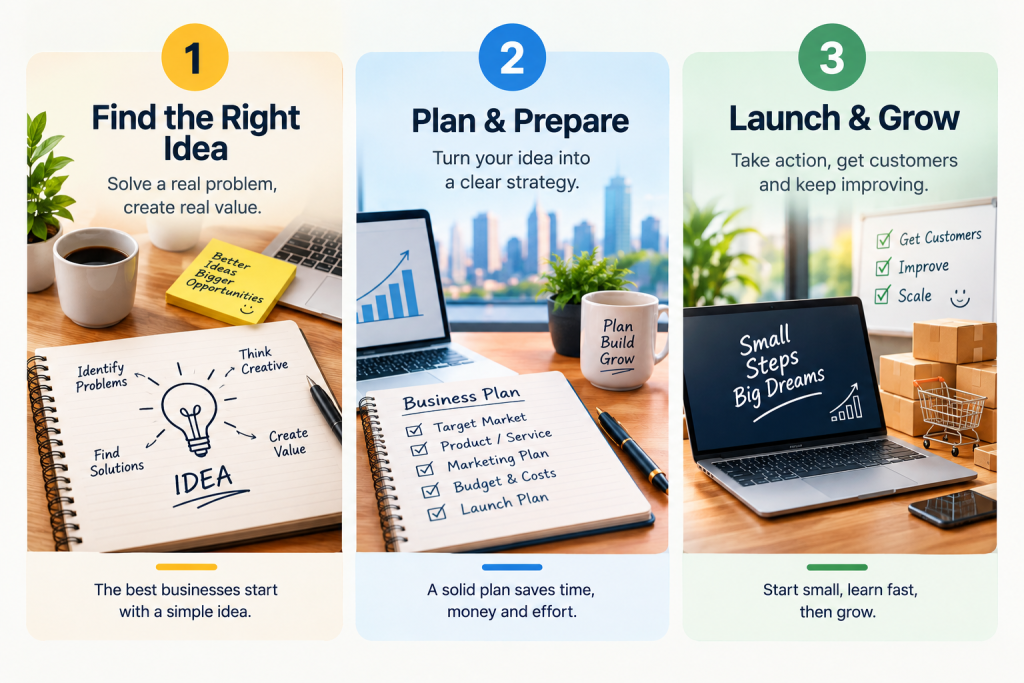
Start With a Problem Worth Solving
A profitable business usually begins with a problem.
Before thinking about a name, logo or website ask yourself what people genuinely need. Look for problems that waste time, cost too much money or create unnecessary frustration.
You can find opportunities in everyday life.
Pay attention to what people complain about. Notice services that are difficult to use. Look at products that customers buy frequently but still believe could be better.
You can also build around a skill you already have.
Writing, design, marketing, programming, education, consulting and many other skills can become businesses when they solve a specific customer problem.
The goal is not to find an idea that sounds exciting only to you. The goal is to find something valuable enough that other people are willing to pay for it.
How to Start a Business in 2026 With the Right Opportunity
The business environment in 2026 gives entrepreneurs access to powerful tools that were once available mainly to large companies.
Artificial intelligence can help with research, content creation, customer support, data analysis and repetitive tasks. Online payment systems make it easier to receive money. Social platforms allow small businesses to reach targeted audiences without relying entirely on traditional advertising.
But technology does not automatically create a successful business.
A weak idea with better technology is still a weak idea.
Choose an opportunity based on customer demand first. Then use modern tools to operate more efficiently.
This approach helps you avoid becoming distracted by every new trend.
Research Your Market Before Investing
Market research can save you from spending money on an idea that has little demand.
Start by identifying your target customer.
What problem are they trying to solve? What are they currently using? What do they dislike about existing options? How much are they willing to spend?
Then research your competitors.
Study their offers, pricing, customer reviews and marketing. Pay close attention to negative reviews because they can reveal gaps in the market.
You should also look at search trends and online discussions related to your idea.
The purpose of research is not to prove that your idea is perfect. It is to discover what customers actually want before you make a major commitment.
Create a Simple Business Model
Once you understand the market decide exactly how your business will make money.
Will you sell products directly to customers? Will you provide a service? Will you charge a subscription? Will you earn through commissions or another model?
Keep the first version simple.
Define your product or service, target customer, price and main sales channel. Then calculate how much it costs to deliver what you sell.
Your business model should leave enough room for profit after expenses.
If the numbers do not make sense on paper they are unlikely to become better simply because you start selling.
Start Lean and Validate Your Idea
One of the smartest decisions a new entrepreneur can make is to avoid unnecessary spending.
You do not need a large office, expensive equipment or a huge inventory before you know whether people want your offer.
Create the simplest useful version of your product or service.
Then show it to real potential customers.
Their response will give you valuable information. If people are interested you can improve the offer and gradually invest more. If they are not interested you can change direction before losing a significant amount of money.
This process is called validation.
It turns your business idea from a guess into something supported by real customer feedback.
Use AI as a Business Tool
AI has become one of the most useful tools available to new entrepreneurs in 2026.
It can help you brainstorm ideas, research competitors, organize information, draft content, analyze customer feedback and automate repetitive tasks.
However, AI should support your decisions rather than replace your understanding of the customer.
Your customers are still the most important source of information.
Use AI to save time and improve efficiency while keeping human judgment at the center of your business.
A small business owner who uses technology intelligently can often accomplish tasks that previously required an entire team.
Build Your Online Presence
Customers often search online before deciding whether to trust a business.
Create a professional online presence that clearly explains what you offer and who you help.
Depending on your business you may need a website, social media profiles, an online store or listings on relevant platforms.
Your online presence does not need to be complicated.
Make sure customers can quickly understand your offer, find important information and contact you easily.
Useful content can also help build authority. Answer common questions, demonstrate your expertise and show customers how your product or service solves their problem.
Get Your First Customers
Your first customers matter more than your follower count.
Start with people who are most likely to need your offer.
Reach them through channels that fit your audience. These may include social media, search engines, referrals, networking, local communities or direct outreach.
Do not try to reach everyone.
A small group of highly relevant potential customers is more valuable than a large audience with no interest in what you sell.
Give your first customers an excellent experience. Ask for honest feedback and use what you learn to improve the business.
Those early customers can become repeat buyers and sources of referrals.
Manage Your Money From Day One
A business can generate sales and still lose money.
That is why financial management matters from the beginning.
Track your revenue, expenses, profit and cash flow. Know exactly how much it costs to operate and how much you need to sell to cover those costs.
Separate personal spending from business finances where appropriate.
Avoid unnecessary subscriptions and purchases simply because other businesses use them.
Spend money where it directly supports customers, operations or growth.
Good financial habits give you more control when the business becomes larger.
Handle Legal Requirements
Before operating officially research the legal requirements that apply to your business.
Depending on your location and industry you may need registration, licenses, permits, tax arrangements or a specific business structure.
Rules differ by location so do not rely on assumptions.
Check the requirements that apply to your situation and seek qualified professional advice when necessary.
Getting the legal foundation right can protect your business from avoidable problems later.
Focus on Customer Experience
Getting a customer is only one part of building a successful business.
Keeping that customer can be even more valuable.
Make the buying process simple. Respond to questions quickly. Deliver what you promised and handle problems professionally.
Customers remember how a business makes them feel.
A strong customer experience can lead to repeat purchases, positive reviews and referrals.
These results can reduce your dependence on constantly finding new customers.

For the latest updates, helpful tips and new articles, visit Trendora.Autos. Stay updated with fresh insights and useful information to keep learning and growing.
Keep Testing and Improving
Your first business model does not have to remain unchanged.
After launching track what customers buy, where they come from and what feedback they provide.
Look for patterns.
If one product consistently performs better than others you may want to focus more attention on it. If a marketing channel produces little value consider changing your strategy.
Successful businesses evolve.
The goal is not to predict everything correctly before launch. The goal is to learn faster than your competitors and use that knowledge to make better decisions.
Frequently Asked Questions
What is the best business to start in 2026?
The best business depends on your skills, resources and market demand. Look for a problem you can solve well for a specific group of customers.
Can I start a business with little money?
Yes. Service businesses and online businesses can often be started with relatively low upfront costs. Start small and validate demand before making larger investments.
Is AI useful for a new business?
Yes. AI can help with research, content, customer support, analysis and repetitive tasks. Use it to improve efficiency while keeping human judgment involved.
How long does it take to start a business?
There is no fixed timeline. A simple business can launch quickly while businesses requiring products, locations or complex legal requirements may take longer.